
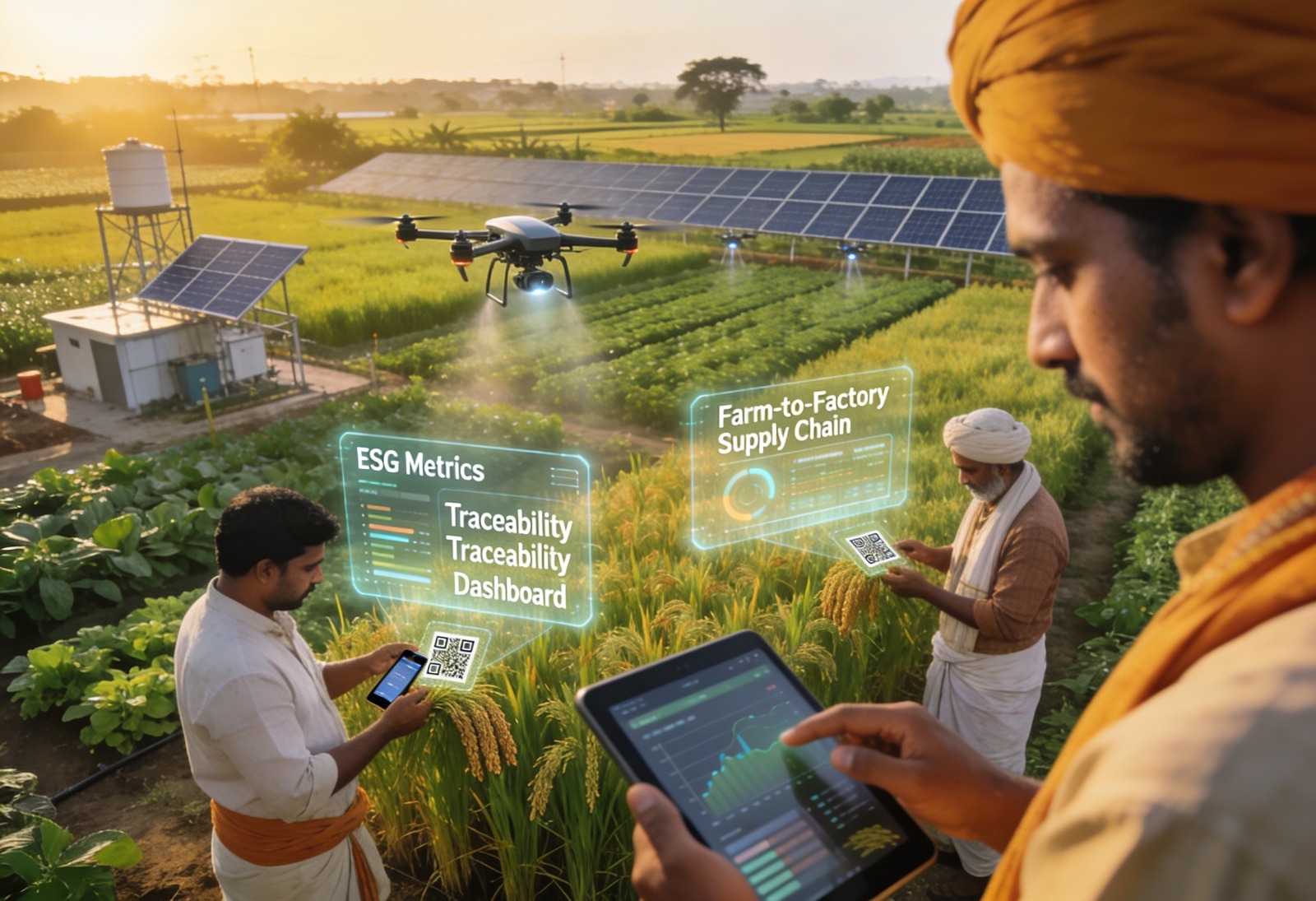
Digital traceability in agriculture is rapidly becoming essential for companies aiming to meet ESG goals and build transparent, sustainable supply chains. In today’s agricultural landscape, sustainability is no longer just a corporate initiative. It has become a business necessity. Governments are tightening environmental regulations, consumers are demanding transparency, and global buyers increasingly expect proof of ethical sourcing and sustainable practices.
At the center of this transformation lies ESG, which stands for Environmental, Social, and Governance standards.
As agricultural supply chains become larger and more complex, one critical question emerges.
Can agriculture truly meet ESG goals without digital traceability?
The short answer is increasingly no.
Understanding ESG in Agriculture and Digital Traceability
ESG refers to a framework used to measure how responsibly and sustainably a business operates.
In agriculture, ESG impacts nearly every stage of the supply chain.
Environmental factors include water usage, carbon emissions, soil health, fertilizer and pesticide management, and biodiversity conservation.
Social factors focus on farmer welfare, fair pricing, labor conditions, community impact, and worker safety.
Governance factors involve compliance tracking, data transparency, ethical sourcing, audit readiness, and supply chain accountability.
For agribusinesses, exporters, distilleries, food processors, and brands, ESG reporting is becoming essential for market access, investor confidence, and long term growth.
You can also explore how digital agriculture is transforming modern farming operations through Trace AgTech’s farm management and traceability solutions.
The Problem With Traditional Agricultural Tracking Systems
Many agricultural operations still rely heavily on paper based records, manual field reporting, Excel sheets, disconnected systems, and delayed data collection.
While these methods may have worked in the past, they create major challenges for ESG compliance today.
Without reliable digital systems, organizations struggle to verify sustainability claims, track farm level activities, monitor emissions accurately, maintain audit ready documentation, and ensure transparency across the supply chain.
Most importantly, manual systems make it difficult to prove that sustainability initiatives are actually happening on the ground.
In modern ESG reporting, proof matters more than promises.
Why Digital Traceability in Agriculture Is Becoming Essential
Digital traceability enables organizations to track agricultural operations in real time from farm to factory.
Using technologies such as mobile field applications, geo tagging, QR code systems, farmer profiling, digital crop records, and centralized dashboards, companies can build transparent and verifiable supply chains.
This creates a powerful foundation for ESG reporting.
Businesses interested in improving transparency can also learn more about farm traceability software and QR based product transparency systems.
How Digital Traceability Supports ESG Goals in Agriculture
Accurate Environmental Monitoring With Digital Traceability
Sustainability reporting requires measurable environmental data. Digital traceability platforms help capture fertilizer usage, water consumption, crop spraying records, carbon related activities, and land mapping data.
With real time digital records, companies can generate more accurate environmental reports and identify opportunities to reduce emissions and resource waste.
This is especially important as agriculture faces increasing pressure to contribute toward global climate goals.
According to the Food and Agriculture Organization, sustainable agriculture and digital innovation will play a critical role in future food systems.
Improving Farmer Transparency and Social Responsibility
The social component of ESG focuses heavily on ethical sourcing and farmer well being. Digital systems help organizations maintain verified farmer records, track payments and procurement, monitor training programs, improve communication with farmers, and reduce operational disputes.
Transparent digital processes build trust across the supply chain while improving accountability.
Organizations implementing farmer management systems often achieve better operational visibility and stronger compliance.
Governance, Compliance, and Audit Readiness Through Digital Agriculture
Governance is impossible without reliable data. Regulatory authorities, certification agencies, and buyers increasingly expect traceable sourcing records, verified procurement data, digital audit trails, and transparent operational workflows.
Digital traceability systems make compliance easier by centralizing records and reducing dependency on fragmented documentation.
Organizations can quickly retrieve reports, validate sourcing claims, and demonstrate accountability during audits.
The World Economic Forum has also highlighted how technology and traceability are reshaping sustainable food supply chains globally.
Consumer Expectations Around Agricultural Transparency Are Changing
Today’s consumers want to know where their products come from, how they were produced, whether farmers were treated fairly, and if sustainability claims are genuine.
This is driving demand for farm to consumer transparency.
QR code enabled traceability is becoming increasingly common in food, beverages, coffee, cocoa, spices, and wine industries.
Consumers are no longer satisfied with generic sustainability labels. They expect verifiable information.
ESG Risks Without Digital Traceability in Agriculture
Without digital traceability, companies face growing operational and reputational risks. These include inaccurate ESG reporting, compliance failures, supply chain disputes, certification challenges, loss of buyer confidence, and reduced export opportunities.
In a competitive global market, lack of transparency can directly impact profitability and brand reputation.
The Future of Sustainable Agriculture Is Data Driven
Agriculture is entering a new era where sustainability and technology are deeply connected.
Digital traceability is no longer just an operational upgrade. It is becoming the backbone of ESG driven agriculture.
Organizations that invest in transparent, data driven systems today will be better positioned to meet regulatory requirements, build consumer trust, improve operational efficiency, achieve sustainability targets, and strengthen long term resilience.
As ESG expectations continue to grow, the agricultural industry must move beyond manual processes and embrace digital transformation.
In the future of agriculture, sustainability will depend not only on what companies do, but on what they can prove.
Conclusion
Can agriculture meet ESG goals without digital traceability?
Some progress may still be possible. However, achieving scalable, measurable, and verifiable ESG compliance without digital systems is becoming increasingly difficult.
Digital traceability provides the visibility, accountability, and transparency required for modern agricultural supply chains.
For organizations aiming to build sustainable and future ready operations, digital traceability is no longer optional. It is essential.

Any comments?