
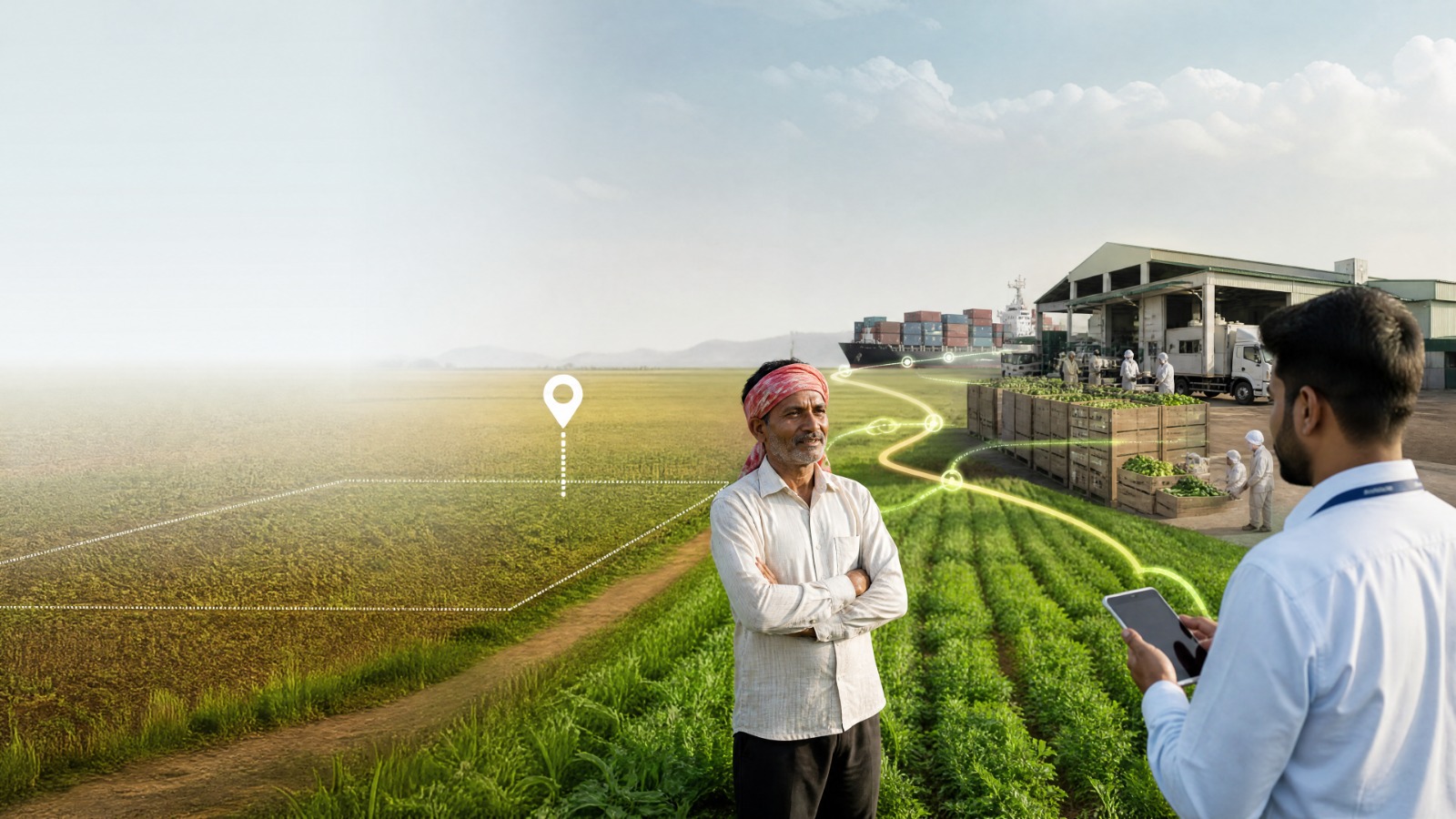
Agriculture is no longer only about producing more. For modern agricultural supply chains, an equally important question is becoming:
Can you prove where your product came from, how it was produced, and what happened to it along the way?
This is where agricultural traceability becomes critical.
From farmer registration and farm mapping to crop activities, procurement, processing, and final dispatch, traceability creates a connected digital record of an agricultural product’s journey.
In 2026, this is becoming increasingly important as global buyers, regulators, certification bodies, and consumers demand greater transparency around the origin, quality, sustainability, and movement of agricultural products.
For agribusinesses, traceability is moving from a compliance requirement to a strategic business capability.
What Is Agricultural Traceability?
Agricultural traceability is the ability to track and verify an agricultural product throughout its supply chain, from its source at the farm to procurement, processing, and distribution.
A digital agricultural traceability system can connect information such as:
- Farmer identity and registration
- Farm location and plot boundaries
- Crop and variety
- Planting and harvesting information
- Farm activities
- Fertilizer and pesticide applications
- Field inspections
- Sustainability practices
- Production and yield data
- Procurement and collection
- Batch and lot information
- Quality and laboratory results
- Warehouse movements
- Processing activities
- Sales and dispatch
Instead of maintaining disconnected spreadsheets, paper records, and separate databases, businesses can create a connected digital chain of information.
The result is greater visibility into where agricultural products originate, how they were produced, and how they moved through the supply chain.
Why Is Agricultural Traceability Becoming More Important?
Agricultural supply chains have become increasingly complex.
A single product may pass through farmers, aggregators, collection centres, warehouses, processors, exporters, and distributors before reaching its final market.
At every stage, information can be lost.
A processor may know the quantity received but not have complete information about the farms that produced it. A buyer may know the supplier but not the individual production locations. A certification team may have records but spend significant time manually matching documents to farms and transactions.
This creates a data gap between production and the final product.
Digital traceability helps close that gap.
1. Global Buyers Want Greater Transparency
International customers increasingly want more than a certificate or supplier declaration.
They want evidence.
They may need to understand:
- Where was the crop produced?
- Which farms supplied it?
- What agricultural practices were followed?
- Were inputs recorded?
- Was the product handled according to required standards?
- Can the product be traced back to its source?
A structured digital traceability system makes this information easier to collect, organize, verify, and retrieve.
2. Regulations Are Increasing the Importance of Supply-Chain Data
Regulatory requirements are another major driver of agricultural traceability.
The European Union Deforestation Regulation, or EUDR, is an important example. It applies to relevant commodities and products associated with commodities such as cocoa, coffee, palm oil, rubber, soy, wood, and cattle.
For businesses covered by the regulation, information about the origin and production location of relevant commodities is an important part of the due-diligence process.
This makes reliable farm-level information increasingly important for companies supplying international markets.
For agribusinesses, collecting this information should not be an activity performed only when a compliance deadline approaches.
It needs to become part of the sourcing and production process itself.
3. Certification Requires Evidence
Agricultural certifications and sustainability programmes often depend on documented evidence.
Whether the requirement relates to responsible agricultural practices, organic production, sustainability, or customer-specific standards, businesses need to demonstrate that their processes are actually being implemented.
Digital farm records can help organizations maintain evidence of:
- Farm practices
- Input applications
- Field inspections
- Training
- Corrective actions
- Geographical information
- Harvest information
- Procurement
- Product movement
This can make certification preparation and internal verification more structured.
From Farm Data to Farm-to-Fork Traceability
One of the biggest limitations of traditional agricultural data management is that information is often collected in isolation.
The farmer record may exist in one spreadsheet.
Procurement data may exist in another system.
Warehouse records may be maintained separately.
Processing information may be recorded somewhere else.
This creates fragmented information.
A modern traceability approach connects these stages:
Farm → Crop → Activity → Harvest → Collection → Batch/Lot → Processing → Warehouse → Dispatch → Buyer
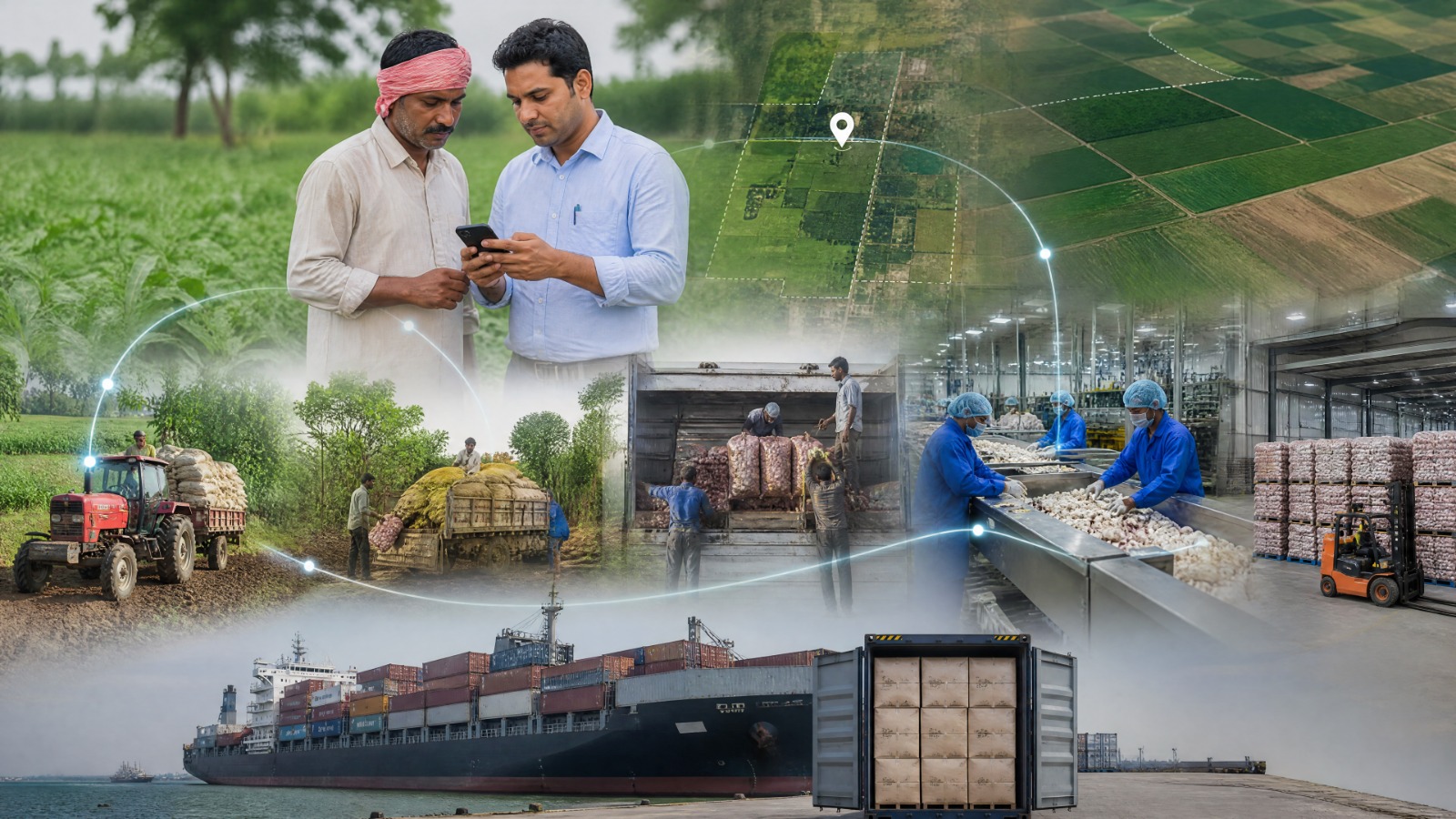
Each stage contributes information to the product’s digital history.
This creates a more complete farm-to-fork traceability model.
For agribusinesses, the objective is not simply to collect more data.
The objective is to create connected, usable, and verifiable data.
The Role of Digital Farm Traceability
Digital traceability starts at the farm.
A business cannot create reliable downstream traceability if it does not know its sources.
This is why farmer and farm profiling are fundamental components of agricultural traceability.
A digital farm record can include:
Farmer Profile
- Farmer identity
- Contact details
- Location
- Registration information
- KYC information
- Farmer code
Farm Profile
- Farm location
- Plot boundaries
- Area
- Crop
- Variety
- Production information
Crop Activity
- Planting
- Fertilization
- Crop protection
- Irrigation
- Field visits
- Harvest
- Other agronomic activities
Evidence
- Photographs
- Geolocation
- Inspection records
- Input records
- Laboratory information
- Supporting documents
When these records are connected to procurement and batch information, businesses can move beyond basic farm management toward actual supply-chain traceability.
Why Geospatial Data Matters in Agricultural Traceability
Location is becoming one of the most important components of agricultural traceability.
Knowing that a company purchased 100 tonnes of coffee or cocoa is useful.
Knowing which farms produced that material is much more valuable.
Geospatial information can connect agricultural production to physical land.
This is particularly important for businesses dealing with requirements involving land use, origin, sustainability, or deforestation.
Technologies such as:
- GPS-based farm mapping
- Perimeter mapping
- Geotagging
- Digital farm profiles
- Geospatial dashboards
can help businesses build a more detailed picture of their agricultural supply chain.
Traceability Is More Than QR Codes
QR codes are often associated with traceability, but they are only one part of a larger system.
A QR code can identify a farmer, batch, lot, or product.
But the value comes from the information behind that identifier.
For example:
QR / Batch ID → Procurement Record → Farmer → Farm → Plot → Crop Activities → Harvest → Processing → Final Product
Without the underlying data, a QR code is simply an identifier.
Effective traceability requires a connected digital information system behind the identifier.
How Trace AgTech Supports Agricultural Traceability
Trace AgTech helps agribusinesses digitize agricultural operations and connect farm-level information with procurement and supply-chain processes.
The platform can support organizations in managing farmer and farm profiles, crop activities, field operations, procurement, traceability, sustainability data, and agricultural supply-chain information.
For Contract Farming Companies
Organizations can digitally manage farmer networks, farm profiles, crop activities, field visits, inputs, inspections, and production information.
This creates greater visibility into contract farming operations while providing businesses with structured farm-level data.
For Processors
Processors need to understand where raw materials originate and how they move through procurement and production.
Digital traceability can connect sourcing information with batches, lots, quality information, warehouse activities, and processing operations.
For Exporters
Export-oriented businesses increasingly need reliable information about the origin and characteristics of agricultural products.
Traceability data can help organizations organize farm-level information and connect it with procurement and supply-chain records to support customer and compliance requirements.
For FPOs and Cooperatives
FPOs and cooperatives manage large numbers of farmers and transactions.
Digitizing farmer registration, farm information, procurement, warehouse, and payout processes can reduce fragmented records and improve operational visibility.
Agricultural Traceability and Sustainability
Traceability and sustainability are closely connected.
A sustainability claim is only as strong as the evidence supporting it.
For example, if a company claims that its agricultural raw material comes from farms following responsible practices, it needs a reliable way to record and verify those practices.
Digital traceability can provide the foundation for monitoring:
- Sustainable farming practices
- Fertilizer usage
- Crop protection
- Farm inspections
- Training
- Environmental information
- Corrective actions
- Production data
- Farm-level sustainability indicators
This transforms sustainability from a reporting exercise into an operational process.
Instead of asking for sustainability information at the end of the season, businesses can collect it throughout the agricultural cycle.
The Data Quality Challenge
Technology alone does not create traceability.
Good traceability depends on good data.
Agricultural businesses commonly face challenges such as:
- Duplicate farmer records
- Incomplete farm information
- Missing geolocation
- Manual data entry
- Paper-based records
- Disconnected systems
- Inconsistent farmer codes
- Missing procurement links
- Unstructured batch information
- Delayed field data
A traceability platform must therefore make data collection practical for field teams and farmers.
Mobile-based data collection, offline capabilities, standardized forms, validation rules, and centralized dashboards can help improve data consistency.
The goal should be simple:
Capture the right information once and make it useful throughout the supply chain.
What Should an Agricultural Traceability System Track?
A practical agricultural traceability system should ideally connect five major layers.
1. Source
Who produced the material?
- Farmer
- Farm
- FPO
- Village
- Location
- Plot
2. Production
How was it produced?
- Crop
- Variety
- Activities
- Inputs
- Inspections
- Harvest
3. Procurement
How was it collected?
- Collection point
- Quantity
- Quality
- Supplier
- Date
- Batch or lot
4. Processing
What happened after procurement?
- Processing activity
- Input quantity
- Output quantity
- Batch transformation
- Quality information
- Warehouse movement
5. Distribution
Where did it go?
- Dispatch
- Buyer
- Shipment
- Destination
- Final product
Connecting these five layers creates a stronger agricultural traceability architecture.
Why Agricultural Traceability Can Become a Competitive Advantage
Traceability is often discussed as a compliance requirement.
But the business value goes further.
A strong traceability system can help companies:
Reduce Information Gaps
Management gets a clearer picture of what is happening across sourcing operations.
Improve Procurement Visibility
Businesses can understand sourcing volumes and their relationship to farmer and farm data.
Respond Faster to Quality Issues
If a problem occurs, businesses can investigate the relevant source, batch, or supply-chain stage more efficiently.
Support Customer Requirements
Structured records can help businesses respond to buyer requests for origin and production information.
Improve Certification Readiness
Evidence is maintained digitally instead of being assembled only when an audit begins.
Strengthen Farmer Relationships
Organizations can build a consistent digital record of farmer interactions, activities, and production.
Enable Data-Driven Decisions
Once farm and procurement information is structured, businesses can analyze productivity, quality, sustainability, and operational performance.
The Future of Agricultural Traceability
The next stage of agricultural traceability will go beyond simply recording transactions.
The future is increasingly about connecting:
Farm Data + Geospatial Data + Procurement + Processing + Sustainability + Analytics + Compliance
Artificial intelligence can then be applied to this structured data to identify patterns, risks, and opportunities.
But AI is only as useful as the data underneath it.
If farm records are incomplete, locations are missing, and procurement data is disconnected, advanced analytics cannot provide reliable answers.
This makes digital data infrastructure a critical foundation for the next generation of agribusiness.
From Compliance to Confidence
The real value of agricultural traceability is not simply being able to answer an auditor’s question.
It is being able to answer fundamental questions about the business at any time:
Where did this product come from?
Which farms produced it?
What happened during cultivation?
How was it procured?
Which batch did it enter?
How was it processed?
Where did it go next?
When these answers are available through connected digital records, businesses gain something more valuable than compliance.
They gain confidence in their supply chain.
Conclusion
Agricultural supply chains are entering a period where transparency, sustainability, data quality, and market access are increasingly interconnected.
For businesses sourcing agricultural commodities, traceability is becoming an essential capability for understanding production, managing suppliers, supporting certification, meeting customer expectations, and preparing for evolving regulatory requirements.
The most effective approach is to start at the source.
Digitize the farmer.
Map the farm.
Record the crop.
Monitor activities.
Track procurement.
Connect batches.
Follow processing.
Build the complete supply-chain story.
Trace AgTech brings these elements together through a digital agriculture and traceability platform designed to help agribusinesses build connected agricultural operations.
As global agricultural supply chains become more transparent and data-driven, the question is no longer simply:
“Can we trace our product?”
It is:
“Can we prove its journey?”
Build a More Traceable Agricultural Supply Chain
From farmer registration and farm mapping to procurement, processing, and supply-chain visibility, Trace AgTech helps agribusinesses build connected digital agricultural operations.
Ready to make your agricultural supply chain more transparent?
Explore how digital farm traceability can work for your organization.

Any comments?