
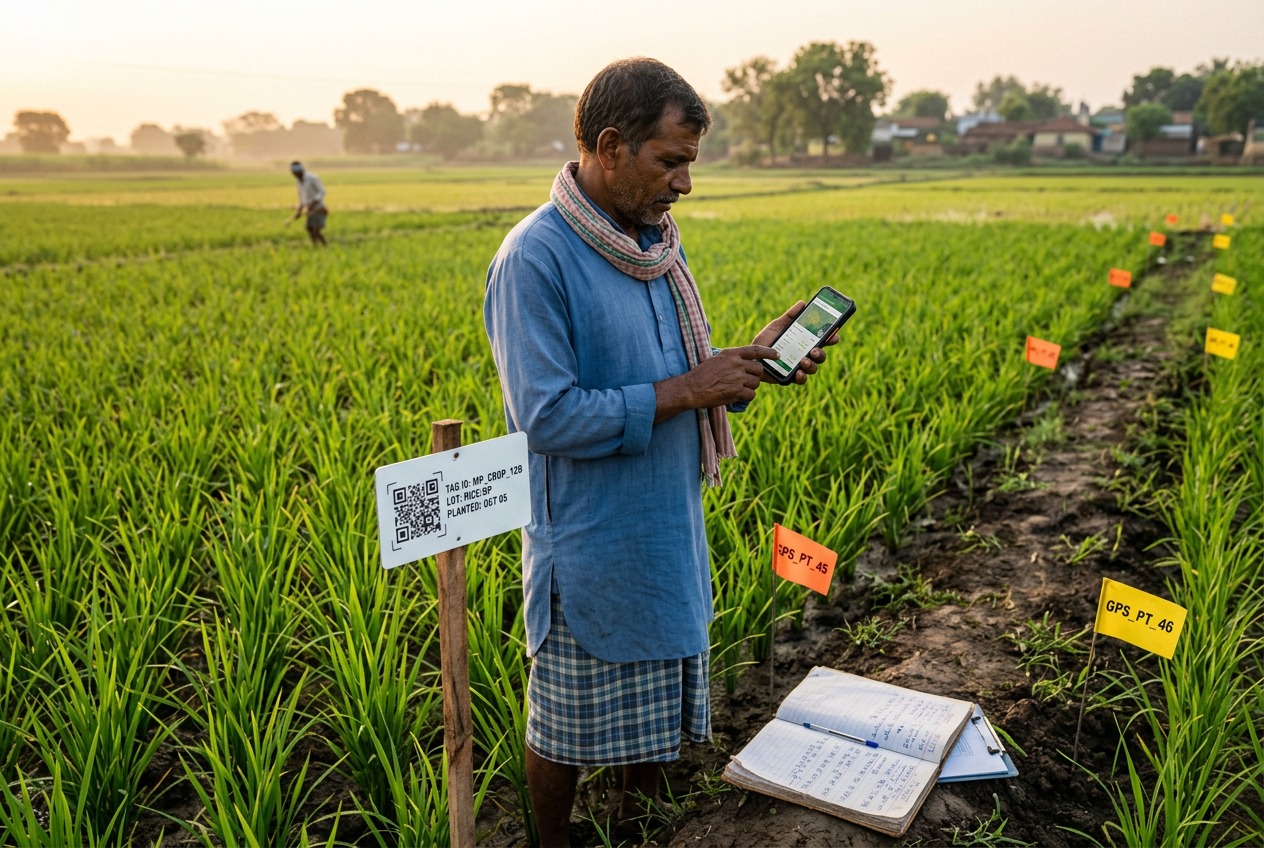
Data-driven agriculture is reshaping how the global food system operates. For decades, farmers and agribusinesses relied on trust, experience, and verbal declarations to conduct business. Today, that approach no longer meets the demands of regulators, buyers, or investors. Every claim, from sustainable farming practices to product origin, must now carry verifiable, structured data behind it.
This shift is not coming. It is already here.
What is Data-driven Agriculture?
Data-driven agriculture is a farming system where teams digitally record every activity, attach a time-stamp, geo-tag the location, and keep it audit-ready at all times. Rather than relying on memory or paper files, it ensures that real, traceable data supports all claims about farm practices, produce quality, and supply chain integrity.
In practical terms, a data-driven agriculture operation can answer with documented precision where a crop was grown, what inputs the team used, how workers harvested it, and who handled it at every stage. Moreover, the system delivers this information instantly, on demand, for any buyer, regulator, or certification body that asks.
Key components of a data-driven agriculture system include:
- Digital farm records
- End-to-end traceability systems
- Audit-ready compliance reports
- Real-time, geo-tagged data capture
- Full supply chain visibility
Why Data-driven Agriculture is Rising in 2026
This shift did not happen overnight. Instead, four converging forces have made verifiable farm data a business necessity rather than an operational nicety: regulatory tightening, sustainability mandates, changing consumer behaviour, and investor scrutiny.
1. Stricter Global Regulations
Export markets now mandate proof of produce origin, evidence of sustainable practices, and transparent supply chains. Furthermore, non-compliance carries real consequences including shipment rejections, loss of certifications, and financial penalties. The compliance window is narrowing, and paper-based systems can no longer keep up. As a result, agribusinesses that still rely on manual records find themselves increasingly locked out of high-value markets.
2. Sustainability Requires Measurable Data-driven Data
Sustainability is no longer a marketing claim. It is a measurable requirement. Businesses must now demonstrate carbon emissions tracking, water usage records, and soil health management with auditable data. Consequently, data-backed sustainability reporting has become the baseline expectation in most regulated markets. In other words, structured data no longer gives companies a competitive edge. It simply keeps them in the game.
3. Consumers Expect Transparency
Modern buyers want to know where their food comes from, how farmers grew it, and whether workers sourced it ethically. Consequently, QR codes, digital traceability records, and product provenance have shifted from differentiators to active purchase drivers. In addition, brands that offer verifiable proof rather than just a promise are winning consumer trust far more effectively in 2026. Since shoppers now make decisions based on sourcing data, transparency has become a commercial necessity.
4. Investors Require Accountability
Agri-investors and financial institutions now evaluate ESG metrics, supply chain risk, and data integrity before committing capital. Therefore, businesses with structured, verifiable data access better funding and carry lower perceived risk. In addition, they build stronger long-term partnerships. Since agri-finance is increasingly ESG-weighted, proof now functions directly as a financial asset.
The Role of Traceability in Data-driven Agriculture
Traceability is the backbone of any data-driven agriculture system. Without it, data stays fragmented, unverifiable, and legally insufficient for most export and compliance purposes.
A farm operation without traceability struggles with siloed records, manual audit reconstruction, inconsistent compliance outcomes, and limited access to premium markets. By contrast, a robust traceability system links every stage of the crop lifecycle, including field mapping, input application, harvesting, storage, transport, and procurement, into one continuous, verifiable chain.
According to the Food and Agriculture Organization (FAO), traceability systems increasingly serve as a prerequisite for food safety governance and international trade compliance. Similarly, GS1’s global traceability standards show that end-to-end visibility reduces food fraud risk and speeds up recall response times significantly. Together, these standards point to one conclusion: traceability infrastructure is no longer optional.
This infrastructure is what transforms raw farm data into proof.
How Trace AgTech Enables Data-driven Agriculture
Trace AgTech builds its platform specifically to support the data-driven agriculture shift. Rather than retrofitting existing farm management tools, the system converts field activities into verifiable, audit-ready records at every stage of the crop lifecycle.
Here is how each capability contributes to data-driven agriculture in practice:
Digital Farmer Profiling Trace AgTech maintains a centralised farmer database with geo-tagged farm locations, detailed crop histories, and activity records. This creates a persistent, verifiable identity for every producer in the network. As a result, it replaces fragmented spreadsheets and inconsistent paper files with a single, structured source of truth.
Real-Time Mobile Data Capture Field executives collect data directly on-device with offline-to-online sync. Because the system time-stamps and geo-tags activities at the moment they occur, teams never need to reconstruct records after the fact. This directly eliminates the data integrity gaps that damage compliance and buyer confidence.
End-to-End Crop Traceability The platform links every stage of the crop lifecycle in a continuous chain, from field mapping through to procurement and dispatch. Additionally, QR-based traceability makes that chain accessible at the point of sale, so buyers and regulators can instantly verify product provenance without waiting for reports.
Sustainability and GHG Tracking Trace AgTech actively monitors carbon emissions, water usage, and input consumption against defined baselines. As a result, businesses generate compliance-grade sustainability reports without manual aggregation. This capability is especially critical for corporate ESG commitments and carbon credit programmes.
Audit-Ready Dashboards When buyers, regulators, or certifiers request documentation, the platform delivers it immediately rather than over days. Real-time analytics and export-ready reports ensure that data-driven agriculture functions as a daily operational reality, not just a stated intention.
To learn more about how the platform works across specific crop types, visit our platform overview or explore our client case studies.
Who Benefits from Data-driven Agriculture?
The transition to data-driven agriculture creates measurable value across the entire supply chain, not just for large enterprises.
Agribusinesses gain improved compliance with global standards, stronger buyer trust, and reduced supply chain risk. Furthermore, they access better pricing through certified provenance and reach ESG-conscious market channels that would otherwise require expensive third-party certification. In short, data-driven agriculture directly strengthens their market position.
Farmers gain a documented record of their practices and access to premium markets. Furthermore, structured farm records simplify loan and input credit processes, which directly improves smallholder financial inclusion. In addition, data-driven agronomic advice helps farmers make better decisions each season.
Consumers gain verifiable product origin at the point of sale and confidence in sourcing and handling claims. Since sustainability certifications now carry real field data behind them rather than brand assertions, consumers can trust what they read on the label.
Challenges in Adopting Data-driven Agriculture
Despite a compelling case, data-driven agriculture adoption involves real operational and infrastructural challenges, particularly in emerging agricultural markets.
Field teams accustomed to paper-based processes often resist digital transformation initially. Additionally, maintaining data entry consistency across large, decentralised farmer networks requires both the right tools and structured onboarding. Unreliable connectivity in rural areas can disrupt real-time data sync, while new platforms must also integrate with existing procurement or ERP systems at the enterprise level.
However, these challenges are solvable. Trace AgTech’s offline-capable mobile collection removes dependency on continuous connectivity. Intuitive field interfaces reduce entry friction. Furthermore, an API-first architecture supports integration with existing enterprise systems without requiring a full platform migration. Because the platform handles the hardest technical problems, adoption teams can focus on change management rather than infrastructure.
The barrier to adoption is lower than most expect. Meanwhile, the cost of not adopting continues to rise with every new regulatory requirement.
From Data to Decision Intelligence
Data-driven agriculture is the foundation, not the ceiling. The infrastructure of verified, structured farm data makes the next generation of capabilities possible, and those capabilities are already emerging in advanced deployments.
AI-driven agronomic insights, predictive yield analytics, automated compliance certification, and carbon credit monetisation tied to verified farming practices all share one prerequisite: reliable, structured, traceable data that teams collect consistently at the source. Without that foundation, none of these tools can function accurately.
Businesses that invest in Data-driven agriculture infrastructure today are therefore not just solving a compliance problem. Rather, they are building the dataset that will power the next decade of agricultural intelligence. According to McKinsey’s AgriTech insights, data-driven farming operations are on track to deliver 10 to 15 percent productivity improvements by 2030, but only for those who already have the data infrastructure in place.
Frequently Asked Questions
What is data-driven agriculture? data-driven agriculture is a system where farming teams digitally record every activity, attach a time-stamp, geo-tag the location, and keep everything audit-ready. It ensures all claims about farm practices and produce quality carry verifiable data rather than declarations.
Why is data-driven agriculture important in 2026? Tightening export regulations, mandatory sustainability reporting, consumer demand for food transparency, and ESG-weighted agri-finance have together made verifiable farm data essential for market access, compliance, and business growth.
What is the difference between farm traceability and data-driven agriculture? Traceability is the infrastructure; data-driven agriculture is the operational paradigm. Traceability systems track and link activities across the supply chain. Data-driven agriculture is the broader commitment to making every farm claim verifiable, with traceability as its core technical enabler.
How does Trace AgTech support data-driven agriculture? Trace AgTech provides digital farmer profiling, geo-tagged field mapping, real-time mobile data capture, QR-based crop traceability, GHG emissions monitoring, and audit-ready dashboards. Together, these tools convert every farm activity into a verifiable digital record.
Is data-driven agriculture only for large agribusinesses? No. Smallholder farmers gain access to premium markets and data-backed advisory services. Mid-sized processors gain compliance documentation. The key is choosing a platform that scales to the size and complexity of the operation.
Data is the New Power in Agriculture
The shift to data-driven agriculture is not a trend. It is the new baseline for doing business in global food and commodity markets. In a world where transparency, sustainability, and accountability drive purchasing and investment decisions, only those who can prove their practices will succeed in the markets that matter.
Trace AgTech turns farm data into verifiable proof, helping agribusinesses build buyer trust, ensure regulatory compliance, and unlock market opportunities that were previously out of reach.
In modern agriculture, it is no longer about what you say. It is about what you can prove.
Ready to build your data-driven agriculture system? Request a free demo or explore the Trace AgTech platform today.

Any comments?